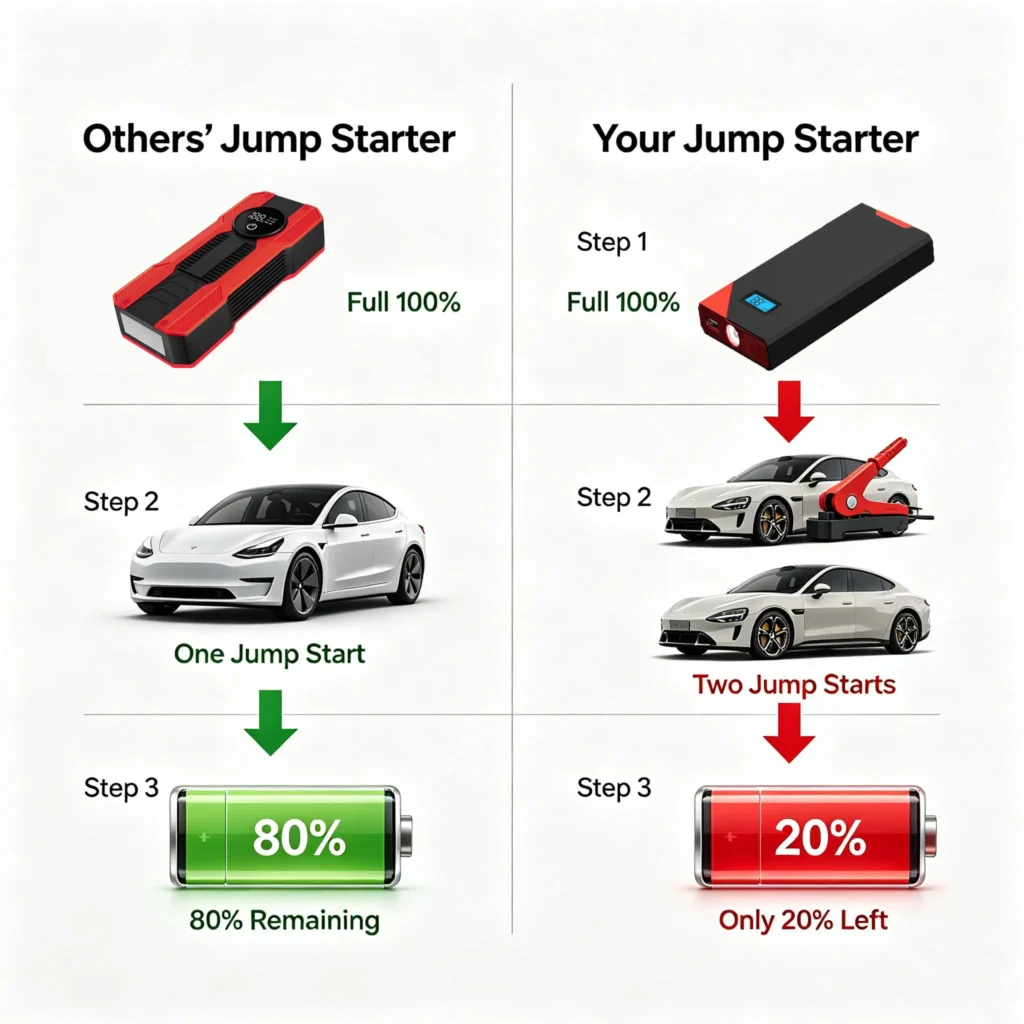
Two jump starters rated at the same 12,000mAh or 16,000mAh can last very different amounts of time. This confuses many car owners. A good unit can sit idle for months and still crank the engine repeatedly. A cheap unit with the same label can lose most of its charge in weeks—or drain heavily after a single start.
As a jump starter supplier, today I’d like to talk about this. Most people assume the label tells the whole story. It doesn’t. Nominal capacity is only a surface-level number. What actually determines endurance is cell quality, standby current, cranking load, cell aging, storage temperature, and charging habits. This article explains each of these factors, so you can avoid common buying and usage mistakes.
1. Rated Capacity Is Not Usable Capacity
Fake capacity is the most common reason same-rated jump starters perform so differently.
To cut costs, many factories swap high-rate cranking cells for ordinary low-current lithium cells. The case still says 16,000mAh, but real usable capacity is often less than half that. This is more than a labeling problem. Engine cranking needs a stable burst of high current—something ordinary digital cells cannot deliver. During a start, cheap cells drop voltage hard, and the system shuts down early even when the screen still shows power left.
Quality jump starters use dedicated high-rate polymer lithium cells, where nominal and usable capacity match. Low internal resistance, stable voltage, and high conversion efficiency keep standby loss low and cranking power steady.
2. Standby Drain: The Power Lost While Doing Nothing
Many owners report that their jump starter loses charge without ever being used. The cause is unoptimized standby current.
Entry-level units use simple circuit boards and weak power management. Protection circuits, displays, USB ports, and indicator lights never enter deep sleep. Even after you switch the unit off, residual current keeps drawing from the cells. Premium units keep monthly self-discharge below 3%. Cheap same-capacity models lose 15%–30% a month, so long storage kills them.
Always-on extras—LED light, tire pressure monitoring, reverse charging—add a small but constant load. The gap is real: a good unit can standby six months with negligible loss, while a budget unit is flat in one to two months.
3. Cranking Load: The Power Wasted During a Start
Two units can do the same job and still drain at different rates. The difference comes from real cranking conditions, not the capacity label.
Engine size matters. A 1.5L or 2.0L gasoline car needs low current and fires quickly. A large SUV, off-roader, or diesel above 2.5L can pull 300A–500A, and that high-rate discharge wastes more energy.
The health of the car battery matters too. A new or slightly worn battery cranks smoothly with little draw. A dead or heavily aged battery forces the jump starter to hold high current for longer, often doubling or tripling the energy used per start.
Internal cell resistance is the third factor. Cheap cells have high resistance, so much of the energy turns into heat instead of cranking power. Quality high-rate polymer cells keep resistance low and put more of the stored energy to work.
4. Cell Aging: Why Old and New Units Behave Differently
Two units with the same label can perform very differently depending on age and cycle count.
Cells built for automotive starting typically handle 500–1,000 charge cycles. Low-grade cells degrade after about 300, and power loss gets faster over time. After one to two years of daily use, deep discharges, or long low-power storage, the cells lose activity and internal resistance rises. The printed rating never changes, but real storage and discharge efficiency drop. Aged cells struggle to hold a full charge, drain fast, and show inaccurate battery levels.
Long-term low-power storage causes permanent damage—lithium loss and internal micro-shorts—which raises self-discharge and turns normal standby into continuous drain.
5. Temperature: Heat and Cold Both Cost Power
Temperature changes how fast a lithium battery drains. Summer heat and winter cold can make two identical units perform very differently.
Inside a parked car in summer, temperatures can exceed 60°C. Sustained heat speeds up chemical reactions, raises self-discharge, and ages cells permanently. In freezing conditions, chemical activity slows and usable capacity drops, so the same start uses a much larger share of what’s left.
Storage conditions matter. Hot, humid, or sun-exposed storage causes both short-term drain and long-term degradation. Cool, dry, shaded storage keeps self-discharge stable and extends service life.
6. Charging Habits: How Users Make It Worse
Even two identical units will diverge based on how they are charged and stored.
Three habits accelerate aging:
- Keeping it at 100% all the time increases cell polarization and self-discharge.
- Frequent shallow cycles without a full cycle weaken cell activity.
- Leaving it at very low power triggers under-voltage protection, doubles aging speed, and increases self-discharge.
Bad chargers add another problem. Incompatible third-party chargers or mismatched cables can show a false 100% while the cells are only partly charged. The unit then drops suddenly during a start, which looks like abnormal drain.
7. Maintenance Tips That Actually Help
You don’t need to replace the unit to fix fast power loss. Better habits are usually enough:
- Avoid fake-capacity products. Choose units with standard high-rate polymer lithium cells and honest usable capacity.
- Turn off extras during storage. Disable LED lights and auxiliary ports. Top up monthly and keep the charge at 50%–70%, the best level for lithium cells.
- Avoid extreme temperatures. Don’t leave it in a hot car in summer or in severe cold in winter. Normal-temperature, shaded storage is best.
- Crank properly. Keep each attempt under 3 seconds and wait at least 1 minute between tries.
- Don’t store it full or empty. Use the original charger to avoid false full-charge readings.
Conclusion: Capacity Is One Number; Quality Decides Endurance
Nominal capacity alone does not determine how long a jump starter lasts. For units with the same rating, six things drive the difference: fake capacity, standby drain, cranking load, cell aging, temperature exposure, and charging habits.
When buying, look at cell grade, circuit power management, and high-rate discharge capability—not just the mAh number. Good storage, charging, and cranking habits will get longer endurance and more reliable standby from any same-capacity unit.
Factory-Direct Jump Starters: Pick Your Favorite Style.PRODUCTS