We use cookies to ensure that we give you the best experience on our website.
Stay up to date on the latest factory news
5K subscribers
Factory updates, always on our radar. Production schedules at your fingertips. We don’t just pass the buck — we’re your “eyes on the ground.” Quality you can see, lead times you can trust. We look forward to connecting with you — your inquiry will never go unanswered.
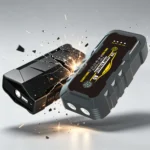
Many customers, when purchasing a jump starter, are most worried about buying a product that uses inferior battery cells from the seller. They are also concerned about whether improper use could lead to safety issues such as explosions.As a professional car jump starter manufacturer , today we will use our product to conduct practical tests and clarify two extreme situations: what will happen in the case of a battery short circuit and a battery being punctured? Will it actually explode? And if an operational error occurs, or when the battery inside the jump starter is damaged by external force, what is the correct way to handle it?
Before the experimental test, let’s first briefly understand the relationship between short circuit and breakdown.
Short circuit
A short circuit refers to the formation of a low-resistance path between the positive and negative terminals of a battery, allowing current to bypass the normal load and flow directly. Based on where it occurs, it can be divided into external short circuit and internal short circuit. An external short circuit occurs when an external conductor mistakenly connects the positive and negative terminals; an internal short circuit occurs when the separator inside the battery is damaged, causing the positive and negative electrode materials to come into direct contact.
Breakdown
Breakdown is essentially a special way of triggering an internal short circuit. When the voltage across the battery terminals is too high, or the separator is physically damaged (by squeezing, puncture, or metal burrs piercing through it), the insulating layer in the middle loses its insulating properties, and the positive and negative electrodes are forced to connect. Therefore, the consequences caused by breakdown are highly consistent with those of an internal short circuit: instantaneous large current, localized high temperature, and structural damage.
Today’s test will be looked at on two levels. First, we’ll look at the actual reaction of the battery cells themselves under short circuit and puncture, so everyone can understand where the physical origin of the risk lies. Second, we’ll look at what the correct emergency handling steps are after an operational error or external force damage occurs. In addition to testing with the finished product, in order to see the battery’s reaction more intuitively, we will also remove the jump starter’s outer casing and conduct the experiment directly with the battery.
Battery clamp misconnection short circuit: From the practical operation video, it can be seen that at the moment the positive and negative poles of battery clamps without intelligent protection are connected in reverse, a large number of sparks will be produced. After clamping, when the battery generates heat and becomes hot, it will be accompanied by battery swelling. In severe cases, smoke will appear, and in very rare cases, combustion will occur.
Battery puncture test: At the moment the battery is punctured by an external object, it will rapidly produce a large amount of thick smoke. The larger the puncture area, the faster and more severe the reaction will be. After reacting for a period of time, the gas that escapes may be ignited upon contact with air, producing sparks and burning the surrounding area.
How to handle jump starter accidents:
When we make a short-circuit misoperation or the battery is accidentally broken down, regardless of whether the battery has already produced thick smoke, never touch it with your hands, because the battery may be extremely hot at this point and you could get burned. In addition, there is no need to panic excessively. We just need to promptly use tools to place the battery into a bucket of water or bury it in sand, isolate the battery properly, and wait for the internal reaction of the battery to finish.
The above is our actual test video from our jump starter factory. If you’d like to see other actual test videos, you’re welcome to leave a comment and follow us.Contact