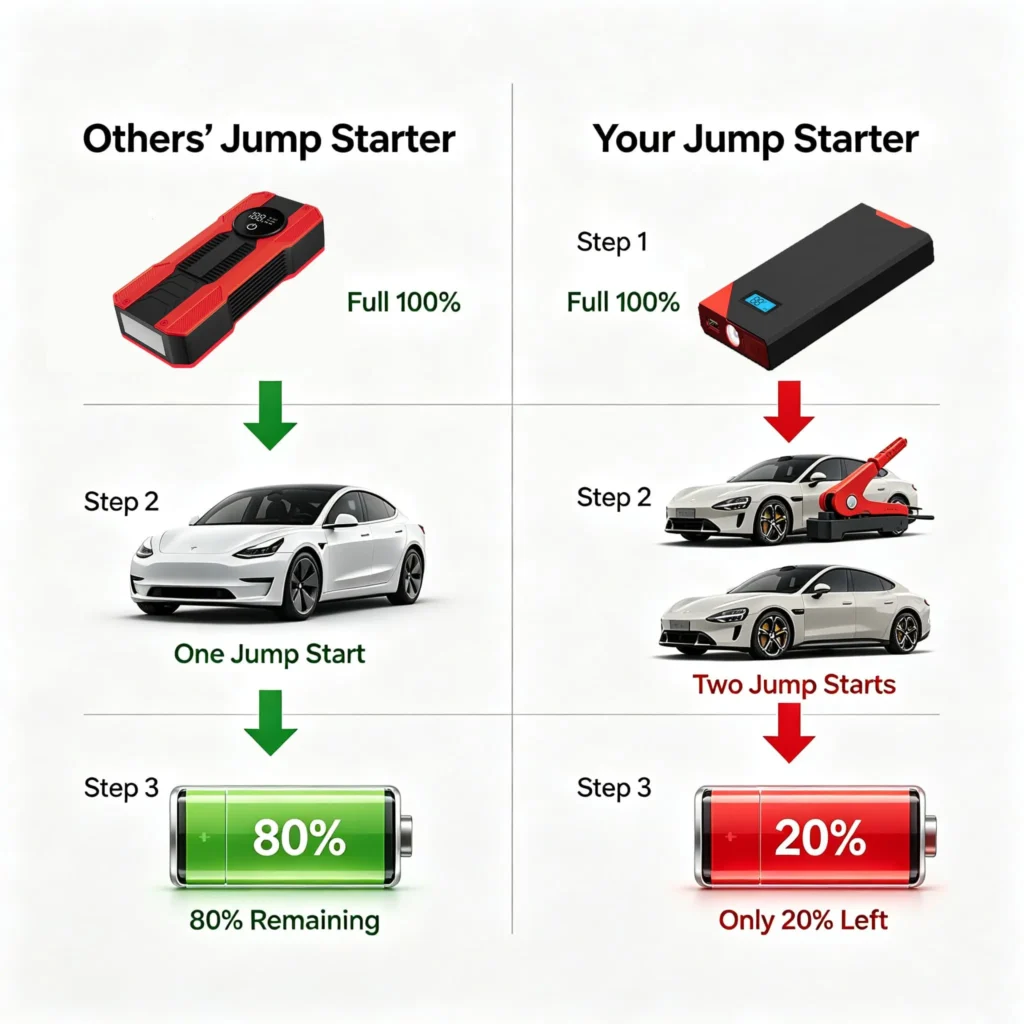
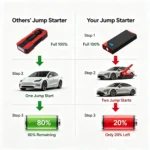
Many car owners face a confusing yet common problem: two car jump starters with identical rated capacity, including mainstream 12000mAh and 16000mAh models, deliver drastically different battery endurance. A high-quality car jump starter can remain idle for months with minimal power loss and support repeated engine cranking after a full charge. In contrast, budget car jump starters with the same rated capacity drain power rapidly within weeks. A single vehicle start can consume most of the stored power, causing abnormal and unexplained battery depletion.Most car owners hold a common misconception that the power drain speed of a car jump starter is fully determined by its labeled capacity. In real automotive application scenarios, however, nominal capacity is merely a superficial parameter, not the core factor that dictates actual battery endurance. Genuine cell quality, hidden standby power consumption, cranking current loss, battery aging level, and extreme storage temperatures are the decisive reasons why same-capacity car jump starters show huge differences in power drainage. Even with identical capacity specs, differences in internal circuit hardware, cranking load conditions, and daily maintenance habits create obvious gaps in long-term usability. This article thoroughly analyzes all root causes of fast power loss in same-capacity car jump starters, helping users avoid typical purchasing and usage mistakes.
1. Major Misconception: Rated Capacity ≠ Usable Capacity
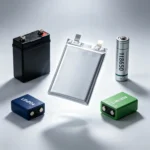
Battery capacity falsification is the most prevalent industry issue leading to fast power drainage in low-cost car jump starters, and it tops the list of reasons for inconsistent performance among identically rated devices. To cut manufacturing costs, many manufacturers replace professional high-rate cranking cells with ordinary low-current digital lithium cells. Although these affordable car jump starters are marked 16000mAh or higher, their real usable capacity is often less than half the advertised rating, misleading numerous ordinary consumers during product selection.Capacity falsification is more than simple parameter deception; it triggers critical defects in high-rate discharge performance, which is essential for vehicle emergency starting. Car engine cranking requires stable instant high-current output, a rigorous working condition that ordinary digital lithium cells cannot support. During startup, substandard cells suffer severe voltage drops, prompting premature system shutdown even when the screen displays remaining power. In short, unqualified car jump starters with fake capacity ratings drain power far faster because their actual usable capacity and discharge performance cannot match their printed specifications.Authentic branded car jump starters adopt dedicated high-rate polymer lithium batteries with perfect consistency between nominal and actual usable capacity. Equipped with ultra-low internal resistance, stable voltage output, and high energy conversion efficiency, these professional-grade devices maintain reliable standby performance and steady cranking power. They effectively avoid abnormal fast power loss and idle power drainage, delivering consistent emergency starting readiness for all types of gasoline and diesel vehicles.
2. Hidden Standby Power Consumption: Silent Power Drain During Idle Storage
A widespread complaint among car owners is unexpected power drainage on idle car jump starters. Many devices lose power quickly even without any cranking, charging, or discharging operations. The hidden culprit behind this silent power loss is unoptimized standby power consumption, one of the most overlooked factors affecting the overall battery life of car jump starters.Entry-level car jump starters adopt inefficient circuit board structures with poor power management algorithms. Internal components including protection circuits, digital display screens, USB output ports, and indicator lights fail to enter deep sleep mode after shutdown. Even after manual power-off, residual current in the circuit continuously drains battery power. Premium professional car jump starters strictly control standby loss, with a monthly self-discharge rate below 3%. In contrast, inferior same-capacity models have a monthly power loss of 15% to 30%, resulting in rapid battery depletion during long-term idle storage.Additionally, most multifunctional car jump starters are built with always-on auxiliary functions such as LED emergency lighting, tire pressure monitoring, and mobile reverse charging. These background features consume tiny yet continuous power during idle periods, accelerating overall drainage. This creates a massive performance gap: high-end same-capacity car jump starters can standby for six months with negligible power loss, while generic budget versions run out of power within one to two months, solely due to inferior circuit power optimization designs.
3. Cranking Condition Loss: Invisible Power Waste During High-Current Starting
Many users wonder why their car jump starter drains power faster even when completing identical cranking operations on similar vehicles. The core reason is that real-time cranking working conditions generate invisible power loss discrepancies that are completely unrelated to rated capacity parameters. Vehicle emergency starting is a dynamic high-load operation, where actual working current directly determines the speed of battery power consumption.Vehicle engine displacement is a key variable affecting cranking power consumption. Compact 1.5L and 2.0L gasoline passenger cars require low instantaneous starting current and short ignition duration, resulting in minimal power loss per startup. On the contrary, large-displacement SUVs, off-road vehicles, and diesel engines above 2.5L require ultra-high instantaneous current ranging from 300A to 500A. This extreme high-rate discharge produces irreversible energy loss, significantly speeding up power drainage on same-capacity car jump starters.The health status of the original vehicle battery also exerts a huge impact on overall power consumption. New or slightly degraded factory batteries crank smoothly and ignite instantly with minimal power draw. However, severely aging or fully dead car batteries force the car jump starter to maintain continuous high-current output for extended periods. Prolonged cranking and repeated ignition attempts drastically increase power usage, often doubling or tripling the energy consumed per startup.Internal cell resistance is another critical factor that distinguishes premium and budget car jump starters. Low-quality cells feature high internal resistance, which wastes large amounts of electrical energy as heat during high-current cranking and reduces effective output capacity. Professional high-rate polymer cells maintain ultra-low internal resistance and excellent energy utilization efficiency, minimizing cranking power waste and delivering stable, long-lasting performance under the same rated capacity.
4. Battery Aging and Degradation: Why Old and New Units Perform Differently
Most car owners overlook the fact that cell aging and performance degradation greatly accelerate power drainage. Two car jump starters with identical labeled capacity can deliver vastly different working efficiency due to differences in service life and charge-discharge cycle times. Professional polymer lithium cells customized for automotive starting typically support 500 to 1000 charge cycles, while low-grade generic cells degrade rapidly after only 300 cycles, resulting in increasingly fast power loss over time.After one to two years of daily use, frequent deep discharge cycles, or long-term low-power storage, the cells inside car jump starters lose chemical activity and develop elevated internal resistance. Although the printed capacity rating remains unchanged, the actual power storage capability and discharge efficiency decline significantly. Aged cells struggle to hold a full charge, drain rapidly with minimal use, and display inaccurate floating battery levels, greatly reducing the emergency reliability of car jump starters.Long-term low-power idle storage causes irreversible cell damage, including lithium element depletion and internal micro-short circuits. These faults drastically raise the battery self-discharge rate, turning normal standby mode into continuous fast power drainage. This is the leading cause of performance decline and rapid power loss in aging car jump starters.
5. Ambient Temperature Impact: Extreme Temperatures Accelerate Power Drainage
Ambient temperature is a vital external factor that directly determines the power retention capability of same-capacity car jump starters. Extreme seasonal temperatures alter the electrochemical activity of lithium batteries, changing self-discharge speed and actual usable capacity, which creates obvious performance gaps in power consumption among identical-spec car jump starters.In hot summer seasons, the temperature inside closed parked vehicles can exceed 60°C. Sustained high heat accelerates internal battery chemical reactions, increases the self-discharge rate of car jump starters, and speeds up permanent cell aging. In freezing winter environments, ultra-low temperatures suppress cell chemical activity and temporarily reduce effective capacity. The user-perceived “fast power drain” happens because the same cranking operation consumes a much larger proportion of the remaining battery capacity.Car jump starters stored in high-temperature, humid, or sun-exposed environments suffer from both short-term rapid power drainage and long-term permanent cell degradation. Repeated extreme heat exposure leads to continuous capacity attenuation and higher equipment failure risks. In comparison, same-specification car jump starters stored in cool, dry, and shaded conditions maintain stable self-discharge rates, slower aging progress, and longer overall service life.
6. Wrong Charging Habits: Human Factors That Worsen Fast Power Loss
Apart from hardware quality and environmental factors, unscientific charging and maintenance habits are major human-induced causes of aggravated fast power loss in car jump starters. Even fully identical-capacity car jump starters will show huge endurance differences due to varied daily usage habits, as improper operations greatly accelerate cell aging and power depletion speed.First, long-term 100% full-charge storage intensifies cell polarization and raises self-discharge rates, resulting in gradual continuous power loss. Second, frequent shallow charge-discharge cycles without complete battery cycling weaken cell activity and create minor memory effects, reducing power storage and discharge efficiency. Third, leaving car jump starters in low-power idle state triggers under-voltage protection, doubles cell aging speed, and causes aggressive self-discharge.Furthermore, using incompatible third-party chargers, low-quality fast charging adapters, or mismatched data cables leads to false full-charge display errors. The car jump starter shows 100% battery level on the screen while the cells remain partially uncharged, causing sudden power drops during cranking and giving users a false impression of abnormal fast power drainage.
7. Effective Maintenance Tips to Fix Fast Power Drain
Users do not need to frequently replace their car jump starters to resolve fast power loss and shrinking battery endurance issues. Adopting scientific usage and maintenance methods effectively reduces unnecessary power waste, delays cell aging, and maximizes the overall service life of car jump starters:1. Avoid unbranded products with fake capacity labels. Choose genuinecar jump starters equipped with standard high-rate polymer lithium cells to guarantee accurate actual capacity, high energy efficiency, and stable cranking performance.2. Disable non-essential functions such as LED lights and auxiliary ports during long-term storage to minimize hidden standby power consumption. Perform monthly maintenance charging and maintain a 50%-70% battery level, the optimal storage state for lithium cells.3. Avoid using or storing the device in extreme temperatures. Keep it away from direct sunlight inside cars in summer and severe cold outdoor environments in winter; normal-temperature shaded storage delivers the best results.4. Standardize cranking operations: limit single cranking time within 3 seconds and wait more than 1 minute between consecutive starts to avoid continuous high-current cell loss.5. Refuse permanent full-charge storage and long-term low-power idle placement. Always use original official chargers to eliminate false full-charge anomalies, slow down cell aging of car jump starters, and stabilize long-term battery endurance.
Conclusion: Capacity Is Only a Parameter; Real Endurance Depends on Overall Quality
In conclusion, the power consumption rate and battery lifespan of car jump starters are never determined solely by nominal capacity. For devices with identical capacity specifications, six core factors dominate power drainage performance: capacity falsification, hidden standby power loss, dynamic cranking load conditions, cell aging severity, extreme temperature exposure, and daily charging maintenance habits.When selecting and using car jump starters, car owners should prioritize core hardware quality including cell grade, circuit power management design, and high-rate discharge capability, instead of only focusing on nominal capacity figures. Scientific storage, charging, and cranking habits enable same-capacity car jump starters to deliver longer endurance and more reliable standby performance, completely solving the problems of unexpected fast power loss and emergency power failure.