We use cookies to ensure that we give you the best experience on our website.
Stay up to date on the latest factory news
5K subscribers
Factory updates, always on our radar. Production schedules at your fingertips. We don’t just pass the buck — we’re your “eyes on the ground.” Quality you can see, lead times you can trust. We look forward to connecting with you — your inquiry will never go unanswered.
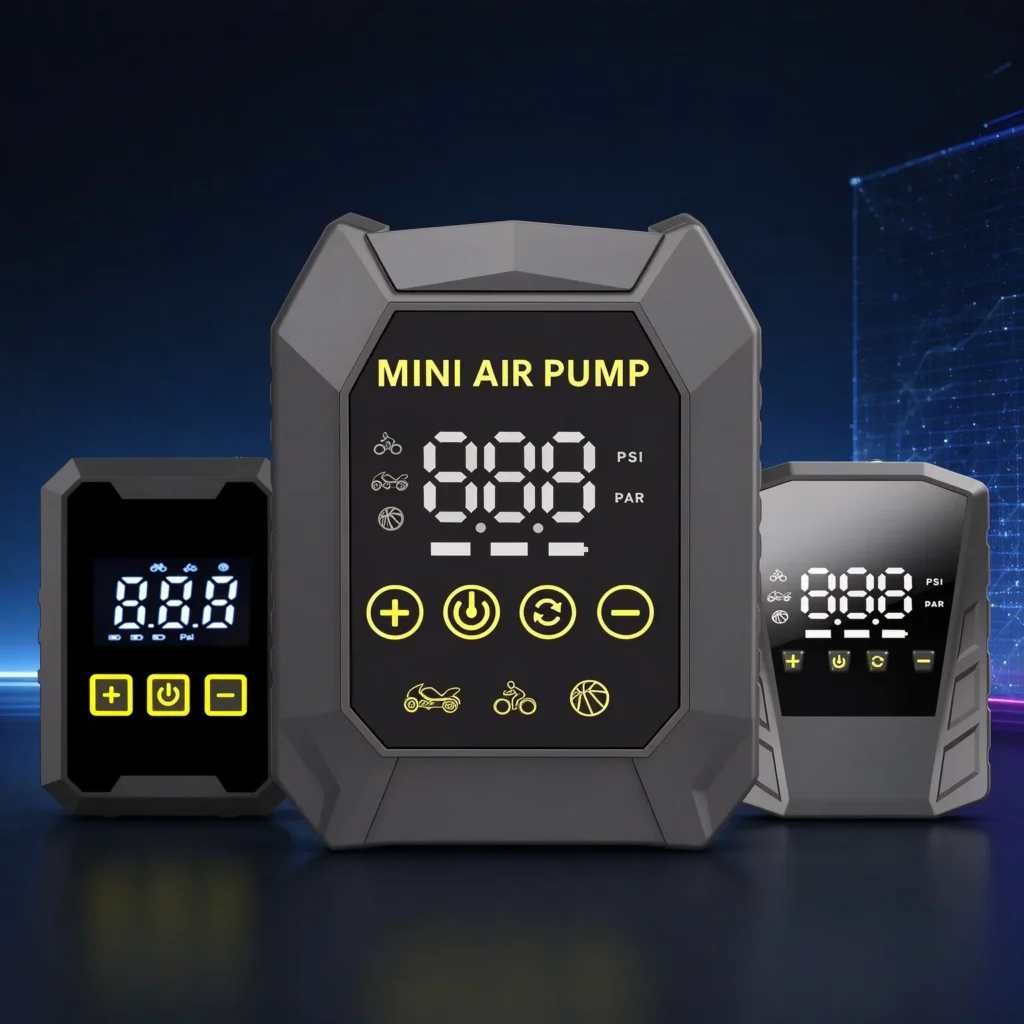
A flat tire mid-ride: a traditional hand pump leaves your arms sore and may still not reach the ideal tire pressure; a jump-starter power bank with a built-in air pump is bulky and inconvenient to carry. In recent years, the electric mini air pump (also called a mini inflator) has quietly grown popular in between these two options—evolving from the early bulky “brick” to today’s palm-sized models costing under a hundred yuan. With so many products on the market now, how should you choose? Today, I’ll break it down from the perspective of a mini air pump factory.
What problem does it solve?
The core selling point of an electric mini air pump is just one: trade battery power for muscle power and time.
Labor-saving and efficient: Anyone who has used a manual pump knows that the high-pressure stage is extremely tiring. With an electric pump, you just set a preset value and press a button—topping up takes only tens of seconds, saving you from sore arms.
Precise tire pressure: Manual inflation often relies on squeezing the tire to estimate, making it easy to over- or under-inflate. Electric pumps come with a digital display and sensor, letting you preset a target pressure and stop automatically when reached, precisely controlling it at the set value (e.g., 30–60 PSI for mountain bikes), which helps with riding safety and efficiency.
Portability you barely notice: The size is usually very small, weighing only about 100–300 grams—you can stuff it directly into a cycling jersey pocket or saddlebag without taking up space. Manual pumps, by contrast, usually require a storage box, which is extremely inconvenient for cycling enthusiasts.
What to look for when choosing
First, noise and heat. Inside an electric pump is a micro piston compressor plus a high-speed motor, and the noise it makes on a quiet mountain road is quite conspicuous. Heat varies by model: some products’ housings can reach 60–80°C when pumping to high pressure, requiring operation through a silicone sleeve or gloves; but some models with better heat dissipation design only rise to 34–47°C, feeling just warm to the touch. This point deserves special attention when buying.
Second, battery life. Several factors affect a pump’s endurance: battery capacity, motor efficiency, heat dissipation capability, inflation speed, etc. Market advertising generally claims how many tires can be inflated on a full charge, but none specify from what PSI to what PSI. As a professional mini air pump factory, we all know that the endurance for 0–60 PSI and 0–120 PSI is different—so if you want battery life that doesn’t disappoint, the parameters must be specific.
Third, the motor. Motors are divided into brushed and brushless types. Brushless motors are more efficient, last longer, and run more quietly and smoothly, so they are usually more expensive. Low-priced products on the market often use brushed motors.
Fourth, match the maximum tire pressure to your bike type. Road bike users need to confirm the pump can reach at least 100 PSI (about 7 bar). Some low-priced models claim a maximum of only around 80 PSI, which is inadequate for road tires. Mountain bikes and city bikes don’t need to chase high numbers.
Fifth, valve compatibility. The vast majority of products support both Presta and Schrader, but the conversion method differs: some use a detachable, reversible valve core, while others include an adapter. If you have multiple bikes or often inflate tires for others, choose the one that’s least mentally taxing to operate.
Sixth, the hose. Models that screw directly onto the valve are the most portable, but your hand is very close to the tire during operation, and vibration transfers directly to your wrist. Models with a short flexible hose take up slightly more space, but during inflation the pump can be placed on the ground or held in your hand—a noticeably different comfort level.
A mini electric pump is not an “upgraded hand pump”—it’s more like insurance: you pay for a low-frequency but troublesome scenario, buying the composure of not having to squat by the roadside frantically pumping hundreds of times. If you enjoy or organize group rides, it deserves a spot in your saddlebag.
If you’re looking for a mini air pump supplier or OEM partner, the selection points above are exactly what we grind over on the production line every day.
As a air pump manufacturer, we don’t win orders with a vague “long battery life”—we turn every model’s measured data into a table that ships with the goods for verification. Take our flagship road bike model:
Test Record: B1/B3/B5 tested at 0–60 / 0–80 / 0–100 / 0–120 PSI.
Test purpose: Inflate common road bicycle tires and common mountain bike tires; record time and range.
Tst content: 0–60 PSI
Tire size
Pressure
Time (s)
Attempt
Remarks
700×25C
0–60 PSI
48
1st
Started fully charged
700×25C
0–60 PSI
50
2nd
After each inflation, wait 40 seconds before continuing.
700×25C
0–60 PSI
52
3rd
700×25C
0–60 PSI
53
4th
700×25C
0–60 PSI
54
5th
700×25C
0–60 PSI
55
6th
700×25C
0–60 PSI
57
7th
700×25C
0–60 PSI
58
8th
700×25C
0–60 PSI
59
9th
700×25C
0–60 PSI
60
10th
700×25C
0–60 PSI
62
11th
700×25C
0–37 PSI
35
12th
Reached 37 PSI; battery died
Tst content: 0–80 PSI
Tire size
Pressure
Time (s)
Attempt
Remarks
700×25C
0–80 PSI
81
1st
Started fully charged
700×25C
0–80 PSI
85
2nd
After each inflation, wait 40 seconds before continuing.
700×25C
0–80 PSI
91
3rd
700×25C
0–80 PSI
93
4th
700×25C
0–80 PSI
97
5th
700×25C
0–80 PSI
108
6th
700×25C
0–80 PSI
120
7th
700×25C
0–14 PSI
13
8th
Reached 14 PSI; auto-stopped when battery died
Tst content: 0–100 PSI
Tire size
Pressure
Time (s)
Attempt
Remarks
700×25C
0–100 PSI
81
1st
Started fully charged
700×25C
0–100 PSI
85
2nd
700×25C
0–100 PSI
91
3rd
700×25C
0–100 PSI
93
4th
5-min interval after 3rd attempt
700×25C
0–80 PSI
97
5th
5-min interval after 4th attempt
Tst content: 0–120 PSI
Tire size
Pressure
Time (s)
Attempt
Remarks
700×25C
0–120 PSI
200
1st
Started fully charged
700×25C
0–120 PSI
250
2nd
5-min interval after 1st attempt
700×25C
0–65 PSI
75
3rd
10-min interval after 2nd attempt
Mountain bike tire: 26×2.125
Tire size
Inflation range
Time (s)
Attempt
Remarks
26×2.125 MTB tire
0–45 PSI
77
1st
Started fully charged
26×2.125 MTB tire
0–45 PSI
79
2nd
After each inflation, wait 40 seconds before continuing.
26×2.125 MTB tire
0–45 PSI
82
3rd
26×2.125 MTB tire
0–45 PSI
85
4th
26×2.125 MTB tire
0–45 PSI
85
5th
26×2.125 MTB tire
0–45 PSI
87
6th
26×2.125 MTB tire
0–45 PSI
89
7th
26×2.125 MTB tire
0–45 PSI
97
8th
26×2.125 MTB tire
0–45 PSI
55
9th
Reached 27 PSI in 55s; battery died
We dare to lay out data like “how many tires can be inflated from 0→120 PSI”—something others are vague about—because every unit is actually tested before leaving the factory. Presta/Schrader compatibility, a hose to dampen vibration, digital display with preset auto-stop—all the points you cared about above have corresponding designs in our products.
For B2B customers, we offer:
Verifiable data: Batch sampling inspection, with measured data sheets provided with each order and support for third-party inspection;
OEM & customization: Logo, packaging, color, and valve solution can be customized, and firmware parameters such as the tire-pressure upper limit can be adjusted to meet channel requirements.
MOQ and lead time: MOQ 10 units, standard models ship in 3–7 days, samples available for testing first;
Certification and quality control: CE/FCC/RoHS and other certifications; factory inspection items include endurance sampling, temperature rise, and air tightness.
Choose products by data first; choose a factory first for partnership. For sample test data sheets or OEM proposals, feel free to contact us directly.Contact Us To Get VIP Service