Most consumers shopping for a car jump starter prioritize core specs such as battery capacity, peak cranking current, and internal cell type, while overlooking a pivotal factor that dominates long-term durability and usage safety: the outer shell material. Many vehicle owners are unfamiliar with the tangible performance differences between PC+ABS alloy, pure ABS, and pure PC plastic housings, three common shell materials for portable car jump starters.The outer casing material of a car jump starter directly affects drop resistance, extreme temperature tolerance, anti-aging capability, operational safety, and overall service life in harsh automotive environments. A key industry puzzle confuses many users: why mainstream high-end branded car jump starters widely adopt PC+ABS alloy shells, while budget entry-level models mostly use pure ABS material, and pure PC shells are rarely applied in commercial products. This in-depth guide professionally compares the performance gaps, practical use cases, unique advantages, and inherent drawbacks of the three materials, helping shoppers identify premium configurations and avoid low-quality defective products.
1. Basic Definition of Three Jump Starter Shell Materials
Before comparing performance differences, it is necessary to clarify the material attributes of PC+ABS alloy, pure ABS, and pure PC, which are the three mainstream plastics for automotive emergency power housings.Pure ABS (Acrylonitrile Butadiene Styrene) is a cost-effective general-purpose engineering plastic with mature mass-molding technology, a sleek surface finish, and flexible color customization. Widely adopted in low-end consumer electronics and ordinary plastic components, it features basic structural toughness but suffers from obvious shortcomings in high-temperature stability and impact resistance, making it unsuitable for harsh long-term automotive environments.Pure PC (Polycarbonate) is a high-grade transparent engineering plastic renowned for exceptional impact resistance, superior heat resistance, and strong compressive structural strength. It is commonly utilized for high-safety automotive components like vehicle headlights and protective covers, boasting far better mechanical performance than pure ABS. Nevertheless, pure PC has notable limitations in molding efficiency, surface texture uniformity, and environmental adaptability for portable electronic devices.PC+ABS alloy is a customized composite polymer material blended with PC and ABS at a scientific optimal ratio. It perfectly merges the high toughness, heat resistance, and structural rigidity of PC with the excellent moldability, premium surface finish, and cost controllability of ABS. This innovative composite material compensates for the inherent defects of single plastic materials, emerging as the most reliable and practical shell solution for professional car jump starters in the automotive accessory industry.
2. Core Performance Differences: PC+ABS vs Pure ABS vs Pure PC
Automotive storage and usage scenarios are extremely demanding: sweltering high heat in enclosed summer vehicles, freezing low temperatures in winter, accidental drops and collisions, long-term UV sun exposure, and persistent driving vibration. These harsh working conditions impose strict standards on the structural stability and environmental adaptability of car jump starter shells. The three mainstream materials show dramatic disparities in core performance indicators tailored for automotive use.
2.1 Impact Resistance & Drop Protection
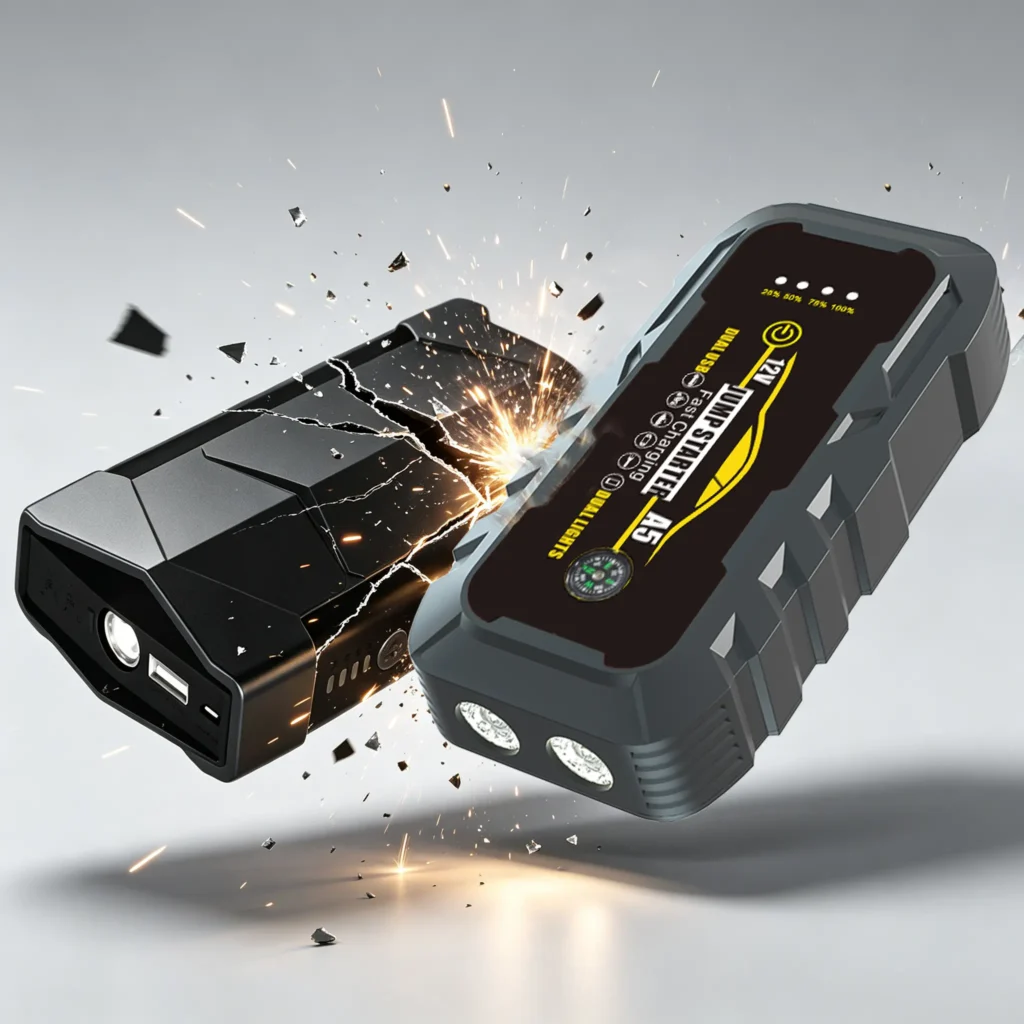
Pure ABS ranks lowest in impact and drop resistance among the three materials, with a notched impact strength of merely 200–300 J/m. During daily use, accidental drops or minor collisions can easily cause car jump starter pure ABS shells to crack, chip, or even partially fracture. Long-term subtle vibration and friction also generate invisible internal micro-cracks, gradually undermining the device’s overall structural stability and shortening service life.Pure PC delivers industry-leading impact resistance, with strength ranging from 600–850 J/m—3 to 4 times higher than standard pure ABS. It withstands severe drops and violent collisions without structural cracking, offering outstanding compression and anti-impact performance. However, pure PC becomes rigid and brittle under extreme low-temperature freezing, prone to white stress marks and structural cracks when subjected to strong external force.PC+ABS alloy achieves an ideal balance of structural toughness and rigidity. Its anti-drop and anti-collision capability vastly outperforms pure ABS and approaches the premium level of pure PC. This blended material eliminates the brittle cracking flaw of pure ABS and the low-temperature embrittlement defect of pure PC. It effectively resists daily drops, accidental collisions, and long-term vibration friction, providing comprehensive and durable structural protection for the internal battery and circuit system of car jump starters.
2.2 High & Low Temperature Resistance & Anti-Aging Performance
The internal temperature of parked vehicles fluctuates drastically from -20°C in freezing winter to over 60°C in hot summer, creating a rigorous endurance test for car jump starter shells. Pure ABS features poor thermal stability, with a heat distortion temperature of only 85°C. Prolonged exposure to high in-car heat causes ABS shells to soften, deform, fade, and age rapidly. In low-temperature environments, ABS loses toughness and becomes highly brittle, significantly increasing the risk of structural damage and cracking.Pure PC boasts exceptional high and low temperature resistance, with a heat distortion temperature reaching 130°C. It maintains stable structural integrity without softening or deforming under high-temperature vehicle conditions and retains stable performance in cold environments. That said, pure PC has weak UV resistance; prolonged sunlight exposure triggers yellowing, material aging, and performance attenuation, greatly reducing the long-term service life of car jump starters.PC+ABS alloy achieves balanced and reliable temperature adaptability, with a stable heat resistance of approximately 100°C, fully compatible with extreme seasonal temperature fluctuations inside vehicles. Through professional blending and anti-aging modification, this composite material optimizes UV resistance, effectively avoiding the high-temperature deformation of pure ABS and the photoaging yellowing of pure PC. It maintains consistent appearance and structural stability after years of cyclic seasonal use.
2.3 Molding Texture & Structural Stability
Pure ABS exhibits excellent melt fluidity and simple molding craftsmanship, delivering a smooth, high-gloss surface with low defective rates and low manufacturing costs. These advantages make it ideal for low-cost mass production. However, pure ABS has poor dimensional stability; post-molding shrinkage and deformation often lead to loose assembly gaps and unstable structural fit in finished car jump starter products.Pure PC features high hardness and precise structural stability but suffers from high melt viscosity and poor fluidity. It is difficult to mold thin-walled, intricately structured shells, with high residual internal stress after processing. This easily causes warping, shrinkage, and surface scratch blemishes, resulting in low finished product yields and substantially higher production costs.PC+ABS alloy integrates the core strengths of both base materials perfectly. It inherits ABS’s superior fluidity and premium surface gloss, ensuring exquisite shell texture and high molding yield rates. Meanwhile, it retains PC’s high rigidity and precise dimensional stability, effectively eliminating post-molding shrinkage, deformation, and residual internal stress issues. The final assembled car jump starter shell is tight, sturdy, and gap-free, delivering superior long-term structural durability.
2.4 Safety Performance & Flame Retardancy
As essential vehicle-mounted emergency electrical devices, car jump starters require shells with reliable insulation and flame retardancy for user safety. Standard pure ABS has inferior flame-retardant properties; it burns easily and spreads flames rapidly in cases of internal short circuits or high-temperature anomalies, posing serious fire safety risks for vehicles and users.Pure PC provides reliable flame retardancy and electrical insulation, effectively blocking current leakage and preventing fire propagation. Yet its fatal flaw is stress concentration under external impact, which triggers local shell rupture and irreversible insulation failure, exposing internal circuits to safety hazards.PC+ABS alloy can be infused with high-efficiency environmental-friendly flame retardants during the blending process, delivering stable flame resistance, leakage prevention, and electrical insulation. It resists cracking and structural failure under impact, providing dual-layer safety protection for internal lithium batteries and circuit systems, fully complying with professional automotive safety certification standards.
2.5 Cost & Market Positioning
Pure ABS boasts the lowest material and processing costs among the three options, making it the dominant shell material for cheap, entry-level car jump starters on the consumer market. These budget-focused products cut costs by sacrificing structural durability and operational safety performance.Pure PC has the highest raw material cost and complicated molding procedures, resulting in low overall cost performance. It is rarely used for full-shell manufacturing of car jump starters and is only applied to individual high-strength protective cover components on premium devices.PC+ABS alloy features moderate production costs and comprehensive balanced performance, achieving the optimal cost-performance ratio for mass-market products. It has become the standard shell configuration for mid-range and professional high-end car jump starters, perfectly balancing safety durability, structural stability, and premium appearance texture.
3. Advantages & Disadvantages Summary of Three Materials
3.1 Pure ABS Shell
Advantages: Ultra-low manufacturing cost, smooth high-gloss surface, simple molding process suitable for mass production, lightweight design for portable use.Disadvantages: Weak impact resistance with high cracking risk; poor thermal stability prone to high-temperature deformation and aging; insufficient flame retardancy leading to potential safety hazards; short overall service life and low structural durability.Applicable scenario: Entry-level car jump starters for infrequent, short-term temporary emergency use, not recommended for long-term vehicle storage.
3.2 Pure PC Shell
Advantages: Industry-leading impact and compression resistance, excellent high-temperature tolerance, high surface hardness, reliable electrical insulation and flame-retardant performance.Disadvantages: Excessively high material and processing costs, complex molding with high internal stress, prone to surface scratches; poor UV resistance causing yellowing aging; low-temperature embrittlement leads to easy cracking under impact.Applicable scenario: Specialized high-strength protective accessories only, unsuitable for full-shell mass production of commercial car jump starters.
3.3 PC+ABS Alloy Shell
Advantages: Balanced toughness and rigidity with excellent anti-drop and anti-collision performance; stable extreme temperature adaptability and anti-yellowing anti-aging capability; delicate molding texture and tight structural assembly; reliable flame-retardant safety and moderate cost performance.Disadvantages: Slightly higher cost than pure ABS materials; extreme impact strength marginally lower than pure PC materials.Applicable scenario: Professional-grade car jump starters for long-term in-vehicle standby and frequent emergency cranking, serving as the mainstream standard configuration in the automotive accessory industry.
4. Why PC+ABS Is the Best Choice for Car Jump Starter Shells
Based on the unique and harsh application scenarios of vehicle emergency starting devices, PC+ABS alloy perfectly remedies the one-sided performance defects of pure ABS and pure PC materials. For automotive-grade portable devices, the outer shell does not require the extreme single-point strength of pure PC, but demands comprehensive and balanced performance: effective drop and collision resistance, stable extreme temperature tolerance, long-term anti-aging durability, exquisite appearance, and certified safety flame retardancy.Pure ABS shells are overly fragile and thermally unstable, easily causing structural damage and device failure during long-term in-vehicle storage and daily emergency use. Pure PC materials have outstanding individual strength but suffer from critical process flaws and poor environmental adaptability, failing to withstand cyclic seasonal temperature changes and daily impact wear. Only customized PC+ABS blended alloy material fully meets the full-scenario usage requirements of car jump starters, explaining why all reputable professional brands adopt PC+ABS as the standard shell material.
5. How to Distinguish Jump Starter Shell Material in Daily Purchase?
Ordinary car owners can quickly and accurately distinguish the three shell materials through simple visual observation and manual inspection, effectively avoiding inferior shoddy products during purchase:1. Look at the surface: Pure ABS has a very smooth and bright surface but is easy to scratch; pure PC has a slightly matte texture with faint water ripples; PC+ABS has uniform gloss, delicate texture, scratch resistance and no easy yellowing.2. Press and shake: Pure ABS shell is soft with slight shaking feeling; pure PC shell is hard and stiff; PC+ABS has moderate hardness, firm structure and no loose shaking.3. Check the parameter label: Regular products will mark the shell material clearly. Prioritize products labeled PC+ABS alloy, and avoid pure ABS low-end models with unknown materials.
Conclusion
In the car jump starter accessory industry, there are no absolutely perfect single plastic materials, only the most practically optimized composite materials. Low-cost pure ABS compromises safety and long-term durability for affordability; high-strength pure PC is limited by poor process adaptability and prohibitive costs; PC+ABS alloy stands out as the industry’s optimal solution by virtue of its all-round balanced performance.For mainstream car owners, selecting a car jump starter equipped with a premium PC+ABS alloy shell effectively avoids common problems such as shell cracking, thermal deformation, photoaging yellowing, and potential safety hazards. It ensures long-term stable standby performance and safe, reliable emergency starting in all weather conditions, making it the most cost-effective and trustworthy choice for daily vehicle emergency tools.